

Best aftermarket Audi headlights in 2026
Best overall: DOT/SAE-marked direct-fit replacement assemblies. Best for stock-style repair: OEM-style replacement housings. Best for a custom beam pattern: projector retrofit assemblies. For 2026, the right aftermarket Audi headlights match your exact vehicle fitment, preserve legal road use, and provide a controlled beam pattern rather than simply adding brighter bulbs. Start by checking the Bayern Motor Werks catalog for parts and accessories matched to Audi, VW, and Porsche applications.
- DOT/SAE-marked direct-fit assemblies are the best aftermarket Audi headlights for most street-driven cars in 2026.
- Choose OEM-style replacement housings when damage, moisture, or broken mounting points require a stock-style repair.
- Projector retrofit assemblies suit custom builds only when fitment, aiming, and road legality are confirmed.
- Bayern Motor Werks is best used to verify Audi lighting-related parts against your vehicle application before ordering.
Why this matters
Headlights are a safety system, not a cosmetic add-on. A headlight assembly controls where light lands, keeps moisture away from electrical components, and gives other drivers a predictable view of your car at night.
In 2026, aftermarket Audi headlights range from direct-fit replacement assemblies to heavily styled housings and retrofit-focused options. Those categories do not solve the same problem. A good choice begins with the failure you are fixing: damaged lens, broken tab, water intrusion, weak output, or a build that needs a different lighting layout.
A headlight assembly also has to work with the vehicle’s existing wiring, mounting points, and lighting equipment. Confirm whether your Audi uses halogen, HID, LED, adaptive lighting, daytime running lights, or an integrated control module before you treat two similar-looking housings as interchangeable.
What makes the best aftermarket Audi headlights
The best aftermarket Audi headlights are not the ones with the most dramatic lens design. They are the assemblies that fit correctly, aim correctly, and retain the functions your vehicle needs in 2026.
- Exact vehicle fitment: Confirm model, generation, body style, production year, left or right side, and lighting configuration.
- Road-use markings: Check for relevant DOT and SAE markings and confirm the assembly is appropriate for your intended use.
- Beam control: A clear cutoff and controlled distribution matter more than raw brightness claims.
- Housing condition: Inspect lens clarity, seals, vents, mounting tabs, adjusters, and connector locations.
- Electrical compatibility: Match plugs, modules, bulbs, ballasts, and daytime-running-light functions before installation.
- Serviceability: Favor an assembly that allows normal access for aiming, bulb service where applicable, and future inspection.
Federal Motor Vehicle Safety Standard No. 108 governs lamps, reflective devices, and associated equipment for vehicles sold for road use in the United States. That does not make every marked aftermarket part automatically right for every Audi. Fitment and installation still decide whether the result works as intended.
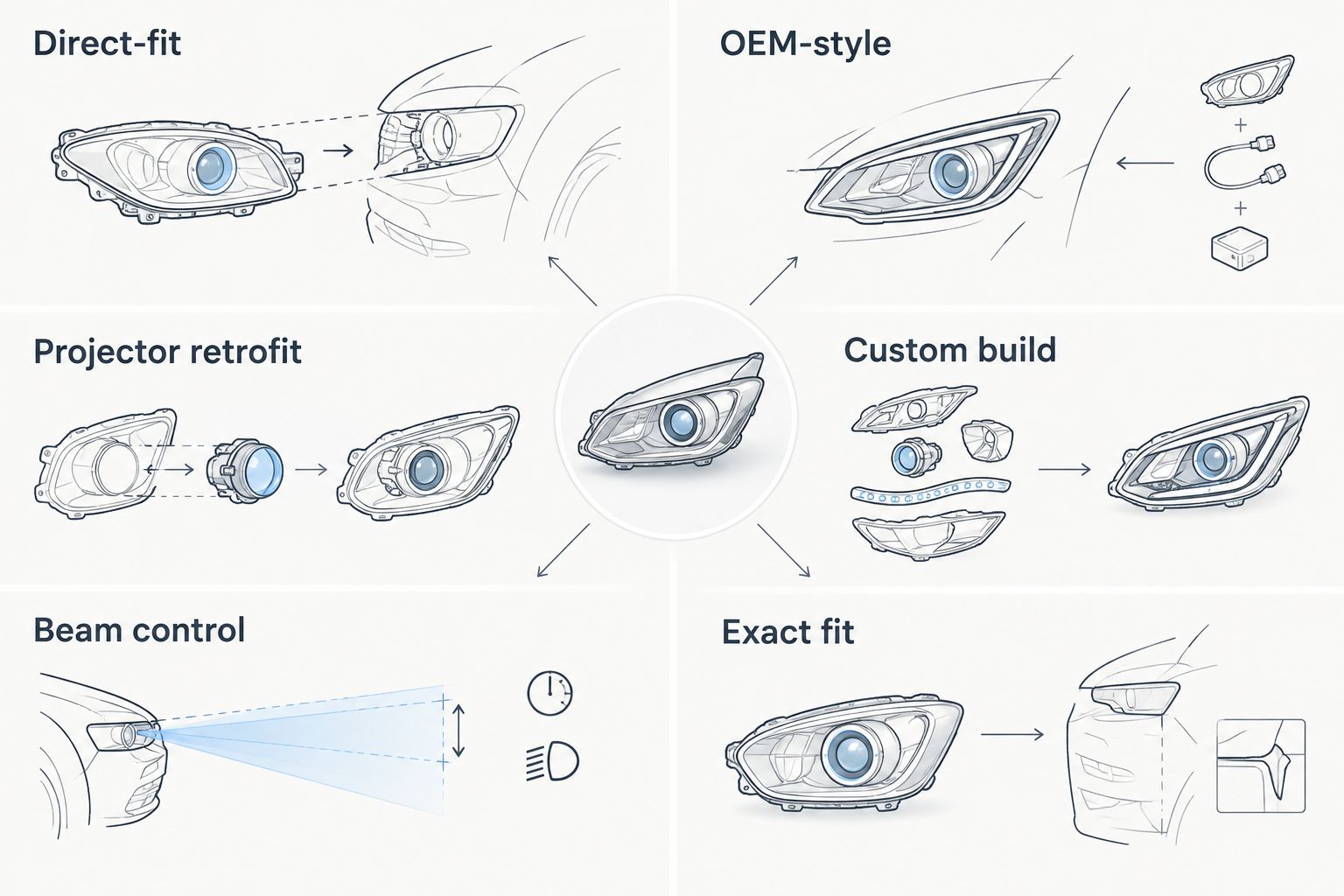
Aftermarket Audi headlights at a glance
| Option | Best for | Standout feature | Key limitation |
|---|---|---|---|
| Direct-fit DOT/SAE-marked replacement assembly | Most daily-driven Audi repairs | Designed around original mounting and lighting locations | Correct application still needs verification |
| OEM-style replacement housing | Stock-style appearance after damage | Familiar layout and service approach | Does not change the vehicle’s lighting concept |
| Projector retrofit assembly | Custom lighting projects | Can support a purpose-built projector layout | Requires more planning for aiming and compatibility |
| Styled aftermarket housing | Appearance-led builds | Changes front-end visual character | Styling does not prove beam quality or legal suitability |
| Lens restoration or repair | Housings that remain structurally sound | Retains the original assembly | Does not fix internal damage, failed seals, or broken tabs |
1. Direct-fit DOT/SAE-marked replacement assemblies: best overall
Direct-fit replacement assemblies are the best aftermarket Audi headlights for drivers who need a straightforward repair without changing the vehicle’s lighting architecture. They are the correct starting point when the original housing is cracked, heavily clouded, leaking, or missing a secure mounting point.
A direct-fit assembly should match the vehicle’s side, mounting layout, connectors, and lighting configuration. Treat the listing’s fitment information as a starting point, then compare it with the part removed from your Audi. A 12-volt system does not mean every headlight connector or lighting module is interchangeable.
Direct-fit replacement assembly pros:
- Built around a vehicle-specific mounting and housing shape.
- Keeps the repair focused on the failed assembly.
- Usually provides the clearest route back to a stock-style front-end appearance.
- Makes correct headlight aiming easier than forcing a universal housing into place.
Direct-fit replacement assembly cons:
- Similar model years can use different lighting equipment.
- A housing can fit physically while lacking a required connector or function.
- DOT or SAE markings do not remove the need to check aiming after installation.
Best for: Daily-driven Audis needing a replacement headlight assembly in 2026.
Verdict: Buy. Choose a direct-fit, appropriately marked replacement assembly when the goal is a proper repair with the fewest variables.
2. OEM-style replacement housings: best for stock-style repairs
OEM-style replacement housings suit owners who want the original design language after collision damage, lens damage, or age-related deterioration. The category matters because the headlight housing is more than a clear lens; it supports reflectors or projectors, seals out water, and provides adjustment and mounting hardware.
An OEM-style housing is the practical answer when your original lighting performance was acceptable and the failure sits in the assembly itself. It is not a reason to install a different bulb type or alter wiring without confirming that the entire system supports the change.
OEM-style replacement housing pros:
- Preserves a familiar appearance for the specific Audi application.
- Avoids unnecessary changes to the vehicle’s front-end design.
- Fits the needs of repair-focused owners better than appearance-first options.
- Keeps your decision centered on fitment, condition, and aiming.
OEM-style replacement housing cons:
- It will not add features absent from the original vehicle.
- Existing electrical faults remain if the housing was not the source of the problem.
- You still need to inspect adjacent wiring, connectors, and mounting hardware.
Best for: Owners replacing a damaged assembly while keeping a stock-style lighting layout in 2026.
Verdict: Buy. Choose OEM-style replacement housings when the original system worked and the physical assembly failed.
3. Projector retrofit assemblies: best for custom lighting builds
Projector retrofit assemblies are for owners planning a deliberate lighting build, not a fast replacement after a broken lens. A projector-based setup uses optics to shape the beam, so the projector, light source, housing depth, cutoff behavior, and final aim must work together.
The attraction is control. The risk is treating a projector retrofit as a plug-and-play appearance part. A correct build needs room inside the housing, secure mounting, heat management appropriate to the chosen components, and final beam alignment on a level surface.
Projector retrofit assembly pros:
- Supports a custom lighting layout rather than a simple stock-style replacement.
- Centers the decision on beam pattern and optical control.
- Gives experienced builders more flexibility in housing design.
- Can suit restoration or modification projects where the original assembly is already being rebuilt.
Projector retrofit assembly cons:
- Requires more installation planning than a direct-fit assembly.
- Incorrect aiming creates glare for oncoming traffic.
- Compatibility with factory modules and functions must be checked part by part.
Best for: Experienced Audi owners building a custom headlight setup in 2026.
Verdict: Hold. Choose a projector retrofit only when you are prepared to confirm every component, installation detail, and final beam aim.
4. Styled aftermarket housings: best for appearance-led builds
Styled aftermarket housings change the visual character of an Audi through lens shape, internal trim, light signatures, or darker finishes. That can suit a project car, but visual changes should never outweigh beam performance and proper installation.
Use this category only after confirming whether the assembly retains the functions your Audi requires. A housing that looks right in product photography can still create problems if its connector layout, mounting tabs, adjustment range, or lighting equipment does not match your vehicle.
Styled aftermarket housing pros:
- Gives a custom build a different front-end appearance.
- Lets owners choose a lighting style that differs from the original housing.
- Can be considered alongside other body and lighting changes.
Styled aftermarket housing cons:
- Appearance is not evidence of beam quality.
- Fitment errors are harder to excuse on visible exterior parts.
- Some options are intended for off-road or show use rather than normal road driving.
Best for: Audi projects where appearance is the priority after fitment and road-use requirements are confirmed.
Verdict: Wait. Do not buy styled aftermarket Audi headlights until you have verified the exact application and intended use.
5. Lens restoration or repair: best for sound original housings
Lens restoration is not an aftermarket headlight assembly, but it belongs in the buying decision because replacement is not always necessary. If the housing is sealed, the mounts are intact, the adjusters work, and the internal optics remain sound, restoring an aged outer lens can be more sensible than replacing the entire unit.
Do not use lens restoration to mask a deeper fault. Condensation that persists, broken mounting tabs, loose internal parts, failed adjustment mechanisms, or damaged wiring point to a repair beyond the outer lens.
Lens restoration pros:
- Retains the original headlight assembly when it remains structurally sound.
- Keeps the scope of the job focused on surface deterioration.
- Avoids changing fitment or electrical connections unnecessarily.
Lens restoration cons:
- Does not fix housing leaks or internal damage.
- Does not repair failed lighting electronics.
- Results depend on the underlying condition of the lens and housing.
Best for: Original Audi headlights with surface lens deterioration but no structural or electrical failure.
Verdict: Buy only after inspection. Restore the lens when the entire assembly remains sound; replace the assembly when it does not.
How to choose the right assembly
Use a simple decision process before buying aftermarket Audi headlights in 2026.
- Identify the failure. Separate a cloudy lens from water intrusion, broken tabs, damaged wiring, and weak or inconsistent output.
- Record the exact vehicle configuration. Model name alone is not enough. Confirm model year, body style, side, lighting technology, and any factory lighting functions.
- Inspect the removed assembly. Compare connector count, mounting locations, module positions, bulb or ballast arrangement, and adjustment points.
- Confirm road-use suitability. Check applicable markings and local requirements before selecting a housing intended for street operation.
- Plan for aiming. Any headlight replacement needs alignment after installation. A properly mounted assembly still needs its beam checked.
Two headlights should be evaluated as a pair even when only one has failed. The undamaged side provides a useful reference for lens condition, mounting position, beam height, and function. It also helps you spot a mismatch before the car returns to the road.
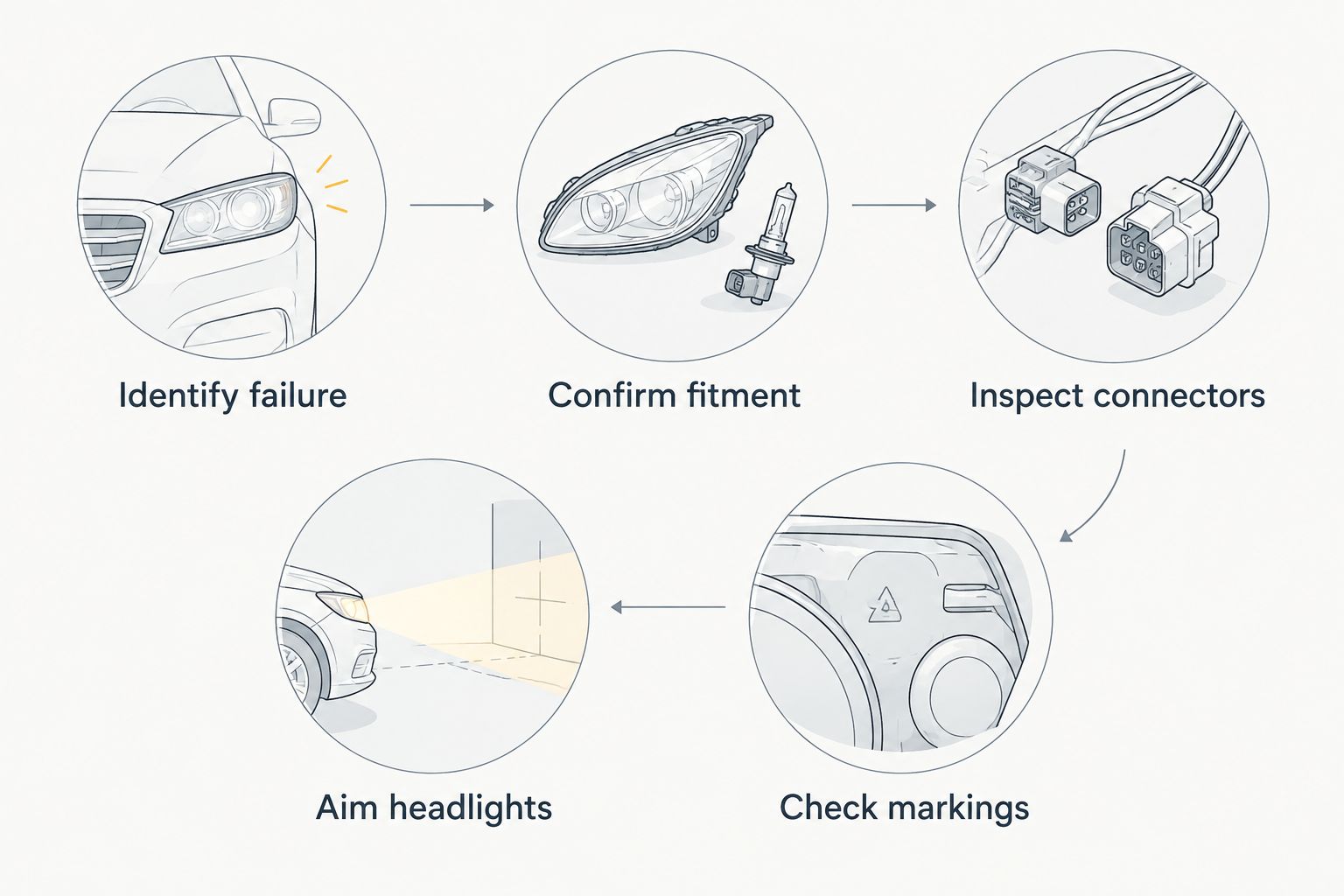
Installation checks that prevent common mistakes
Headlight fitment errors usually begin before the first fastener is removed. Verify the replacement side, inspect the shipment for lens damage and broken tabs, and compare the new assembly with the original before disconnecting anything.
During installation, do not force connectors or mounting points. A connector that does not seat properly is a fitment warning, not a problem to solve with pressure. Keep hardware organized, inspect seals around access covers, and make sure vents are unobstructed.
After installation, confirm all required functions before reassembling trim. Then aim the headlights on level ground according to the vehicle service information and applicable requirements. Aiming is a functional step, not a finishing touch, in 2026.
Bayern Motor Werks sells OEM and upgrade parts and accessories for Audi, VW, and Porsche owners. For a lighting-related purchase, use the available application details to narrow the part before you rely on appearance or a broad model-family description.
How we ranked aftermarket Audi headlights
This ranking puts direct fitment, road-use suitability, beam control, electrical compatibility, housing condition, and serviceability ahead of styling. It does not treat every aftermarket housing as equal because Audi lighting systems vary across generations and equipment levels.
The default recommendation is deliberately conservative. A direct-fit replacement assembly earns the top position because it addresses the most common repair need with fewer changes to the vehicle. Projector retrofits and styled housings have a place, but they demand more verification and carry more installation risk.
Which aftermarket Audi headlights should you choose?
Choose direct-fit DOT/SAE-marked replacement assemblies if you want the best aftermarket Audi headlights for a daily-driven vehicle in 2026. They are the clearest match for damaged, leaking, or deteriorated factory housings when the goal is a correct repair.
Choose OEM-style replacement housings when you want to retain the original look. Choose projector retrofit assemblies only for a planned custom build. Choose styled housings only after proving that fitment, functions, and intended road use are right for your Audi.
Bayern Motor Werks is best for Audi owners who need to compare vehicle-specific parts and accessories without assuming every similar-looking headlight fits the same application.
FAQ
What are the best aftermarket Audi headlights in 2026?
The best aftermarket Audi headlights in 2026 are DOT/SAE-marked direct-fit replacement assemblies for your exact vehicle configuration. They prioritize fitment, controlled light output, and stock-style repair over cosmetic changes.
Are aftermarket Audi headlights legal?
Aftermarket Audi headlights are legal only when they meet applicable road-use requirements and are installed and aimed correctly. Check relevant markings, local rules, and the intended use before purchase.
Is an OEM-style headlight better than a styled aftermarket housing?
An OEM-style headlight is better when you need a stock-style repair with fewer fitment variables. A styled aftermarket housing is for appearance-led builds and requires the same checks for function, mounting, and beam aim.
Do I need to replace both Audi headlights at once?
You do not always need to replace both Audi headlights at once, but you should inspect both assemblies together. The working side helps you compare lens condition, mounting position, and beam alignment after repair.
Can I put LED bulbs in aftermarket Audi headlights?
Do not assume LED bulbs work correctly in every aftermarket Audi headlight housing. The bulb type, optics, wiring, heat management, and legal road-use requirements must match the specific assembly.
Why do replacement headlights need aiming?
Replacement headlights need aiming because the housing position and adjustment points affect where the beam lands. Poor aim reduces useful visibility and can create glare for other drivers.
What should I check before ordering an Audi headlight assembly?
Check the exact vehicle application, left or right side, lighting technology, connector layout, modules, mounting points, and road-use markings. Compare the listing details with the assembly removed from your Audi.
One last thing
Do not let a clear lens decide the purchase. The better 2026 check is whether the assembly matches your Audi’s connectors, mounts securely, supports the required lighting functions, and can be aimed correctly after installation. That is the difference between a replacement that looks acceptable in the driveway and one that works properly on the road.