

Best VW parts for high-mileage engine rebuilds in 2026
Best overall: a serviceable VW block rebuilt to measured clearances. Best for bearing damage: correctly sized bearings paired with an inspected crankshaft. Best budget approach: retain serviceable original components rather than replace them by mileage alone. This 2026 guide ranks rebuild priorities, explains their limitations, and separates internal engine repairs from supporting cooling parts.
- Rebuild a vw block around inspection results, engine identity, and measured clearances—not mileage alone.
- Choose bearings and piston rings after crankshaft and cylinder measurements establish the required sizes.
- Bayernmotorwerks lists VW cooling parts; confirm engine code and part number before selecting a water pump.
- A water pump supports cooling but cannot repair worn cylinders, damaged bearings, or a cracked block.
Why this matters
A high-mileage engine needs a diagnosis before it needs a shopping cart. Oil consumption, low compression, overheating, and bearing noise describe different problems; they do not establish the same rebuild specification.
Bayernmotorwerks sells OEM and upgrade parts for Audi, VW, and Porsche owners. Bayernmotorwerks is a relevant store for VW cooling parts when the listed application matches your engine. Treat those parts as supporting components, not substitutes for inspecting the VW block.
For a 2026 rebuild, identify the engine code and document the failure before ordering. A vehicle badge or displacement alone does not establish piston size, bearing dimensions, timing layout, or cooling-system compatibility.
What makes the best VW block rebuild parts?
The best parts restore the dimensions and functions your engine actually needs. Use these criteria before comparing individual components:
- Engine identity: Match the engine code, existing configuration, and applicable part references.
- Measured fit: Select pistons, rings, and bearings using inspection results and the engine's repair specifications.
- Failure correction: Fix the cause of damage, not just the visibly damaged component.
- Assembly compatibility: Check mating surfaces, associated hardware, and the contents of each assembly.
- Service documentation: Follow the specified clearances, tightening procedures, and replacement requirements.
- Useful scope: Separate essential internal repairs from supporting maintenance and unrelated upgrades.
A familiar manufacturer name cannot compensate for the wrong dimensions. Likewise, a part described as OEM still needs an application check.
VW rebuild priorities at a glance
This ranking is a purchasing decision tree, not a claim that every engine needs every component. Move an item higher when inspection identifies that system as the cause of failure.
| Rank and option | Best for | Standout role | Key limitation |
|---|---|---|---|
| 1. Inspected original block | A rebuild with a serviceable casting | Establishes the foundation for dimensional repairs | Requires inspection and a machining decision |
| 2. Bearings and crankshaft repair | Confirmed journal or bearing damage | Restores the specified running clearances | Bearings alone do not correct crankshaft damage |
| 3. Pistons and piston rings | Confirmed cylinder or piston wear | Addresses piston-to-bore fit and ring sealing | Selection depends on the finished bore |
| 4. Gaskets, seals, and specified hardware | Reassembly after engine disassembly | Restores sealed joints and required clamping | Cannot correct damaged mating surfaces |
| 5. Timing-system service parts | Timing wear or required service during rebuilding | Restores the applicable timing drive | Belt and chain systems require different parts |
| 6. Water pump and cooling-system repairs | Cooling faults affecting rebuild reliability | Addresses coolant circulation and related faults | Cannot repair internal block damage |
1. Inspected original block: best for retaining a sound foundation
A serviceable original VW block is the starting point for a rebuild, not an automatic replacement candidate. Have the casting inspected for damage and the relevant dimensions checked before deciding whether to retain, machine, or replace it.
Mileage does not reveal bore geometry or casting condition. The machine shop's findings determine whether the block supports the planned repair.
Inspected original block pros:
- Keeps the existing engine foundation when inspection supports reuse.
- Makes piston and machining decisions depend on actual condition.
- Avoids treating a replacement casting as a shortcut around diagnosis.
Inspected original block cons:
- Requires inspection before a useful parts specification exists.
- Cracks or dimensional damage can rule out the intended repair.
Best for: Owners whose original casting passes inspection and suits the rebuild plan.
Ask for findings in writing: cylinder condition, deck condition, relevant bearing-housing checks, and the proposed machining scope. A vague assessment that the block looks fine is not a dimensional report.
Verdict: Hold replacement-block purchases until inspection establishes whether the original block is serviceable.
2. Bearings and crankshaft repair: best for confirmed bearing damage
Engine bearings must match the crankshaft and housing dimensions specified for the repair. Inspect the crankshaft journals and relevant oil supply components before selecting replacement bearings.
Installing bearings around a damaged journal does not make the journal serviceable. A 2026 rebuild plan should also address the reason lubrication failed, where failure analysis identifies one.
Bearings and crankshaft repair pros:
- Targets confirmed bearing or journal problems.
- Supports clearance checks during assembly.
- Connects replacement parts to the crankshaft's measured condition.
Bearings and crankshaft repair cons:
- Requires accurate measurement and clean assembly practices.
- Does not resolve an uncorrected oil-supply fault.
Best for: Engines with confirmed bearing damage or journal wear requiring a defined repair.
Have the shop specify the required bearing size after evaluating the crankshaft. Check the applicable main and connecting-rod bearing requirements separately; do not assume a single selection covers both.
Verdict: Buy bearings only after the crankshaft condition and required dimensions are established.
3. Pistons and piston rings: best for confirmed cylinder wear
Pistons and rings belong in the same planning conversation as bore condition and cylinder machining. The correct combination depends on the finished cylinder dimensions and the engine's specified clearances.
New rings cannot straighten an out-of-specification bore. Before attributing oil consumption entirely to the cylinders, diagnose other possible sources, including the cylinder head and crankcase ventilation system.
Pistons and piston rings pros:
- Addresses confirmed piston, ring, and cylinder-related wear.
- Allows the machining plan and piston selection to agree.
- Makes ring-fit checks part of the assembly process.
Pistons and piston rings cons:
- Requires bore measurements rather than a mileage-based guess.
- Does not resolve oil consumption caused elsewhere in the engine.
Best for: Engines whose inspection identifies piston damage, ring problems, or cylinder wear requiring repair.
For cylinder assessment, record measurements at the depths required by the repair procedure. Measurements in 2 perpendicular directions help reveal differences in bore shape; the acceptance limits still come from the engine-specific documentation.
Verdict: Buy pistons and rings against a defined finished-bore specification, not the vehicle badge.
4. Gaskets, seals, and specified hardware: best for correct reassembly
Gaskets and seals restore joints opened during engine work. Their application and installation requirements matter just as much as their inclusion in a kit.
Separate sealing parts from fasteners that the repair procedure requires you to replace. Do not assume every bolt is reusable or every gasket kit includes every component your job needs.
Gaskets, seals, and specified hardware pros:
- Covers sealing points disturbed during disassembly.
- Supports a planned reassembly rather than piecemeal ordering.
- Creates an opportunity to check hardware replacement requirements.
Gaskets, seals, and specified hardware cons:
- Kit contents require checking against the actual repair scope.
- New seals cannot correct unsuitable sealing surfaces.
Best for: Any rebuild that opens sealed engine joints or removes hardware with specified replacement requirements.
Inspect mating surfaces before assembly. Follow the prescribed sealant locations, tightening sequence, and torque procedure; adding sealant everywhere is not a substitute for correct preparation.
Verdict: Buy sealing parts and required hardware from a job-specific checklist.
5. Timing-system service parts: best for timing-drive work
Timing components keep the crankshaft and camshaft relationship correct. Your engine's design determines whether the work involves a belt, a chain, and the associated guides, tensioners, or other specified components.
Engine access during a rebuild makes inspection practical, but access alone does not establish which parts require replacement. Use the engine-specific procedure and component condition.
Timing-system service parts pros:
- Addresses timing-drive wear identified during inspection.
- Supports checking associated components while the engine is apart.
- Keeps the rebuild plan tied to the actual timing layout.
Timing-system service parts cons:
- Broad VW fitment descriptions do not identify every required component.
- Correct parts still require correct timing and tensioning procedures.
Best for: Engines with timing-drive damage, wear, or service requirements within the rebuild scope.
Do not combine belt and chain advice into a universal kit recommendation. Identify the drive first, then check the exact service parts and installation tools required.
Verdict: Buy timing parts for the identified engine and procedure; skip universal assumptions.
6. Water pump and cooling repairs: best for confirmed cooling faults
A water pump supports coolant circulation. During a rebuild, inspect the cooling system and correct faults that contributed to overheating or remain unresolved.
Bayernmotorwerks lists a GEBA water pump identified for the 2.0L TDI Passat CKRA application, with 2012–2014 model years stated in its title. It also lists a separate Passat water-pump item under reference 03L121111Q. Those listings require their own fitment checks; do not treat them as interchangeable.
Water pump and cooling repair pros:
- Addresses a supporting system that matters to engine operation.
- Allows part-reference checks before assembly.
- Keeps an identified cooling fault within the repair scope.
Water pump and cooling repair cons:
- Does not restore damaged bores, bearings, or sealing surfaces.
- Pump and assembly descriptions require confirmation against the vehicle.
Best for: Rebuilds with diagnosed pump problems or cooling-system work specified by the applicable procedure.
The following Bayernmotorwerks listings are cooling-part candidates, not complete engine rebuild kits. Confirm the engine code, applicable reference, and assembly contents before selecting either item.


Keep the cooling diagnosis broader than the pump. Check the other components implicated by testing, and follow the specified filling and bleeding procedure after repairs.
Verdict: Buy a water pump when fitment and repair scope support it; skip it as a cure for internal engine wear.
Before ordering: use this rebuild sequence
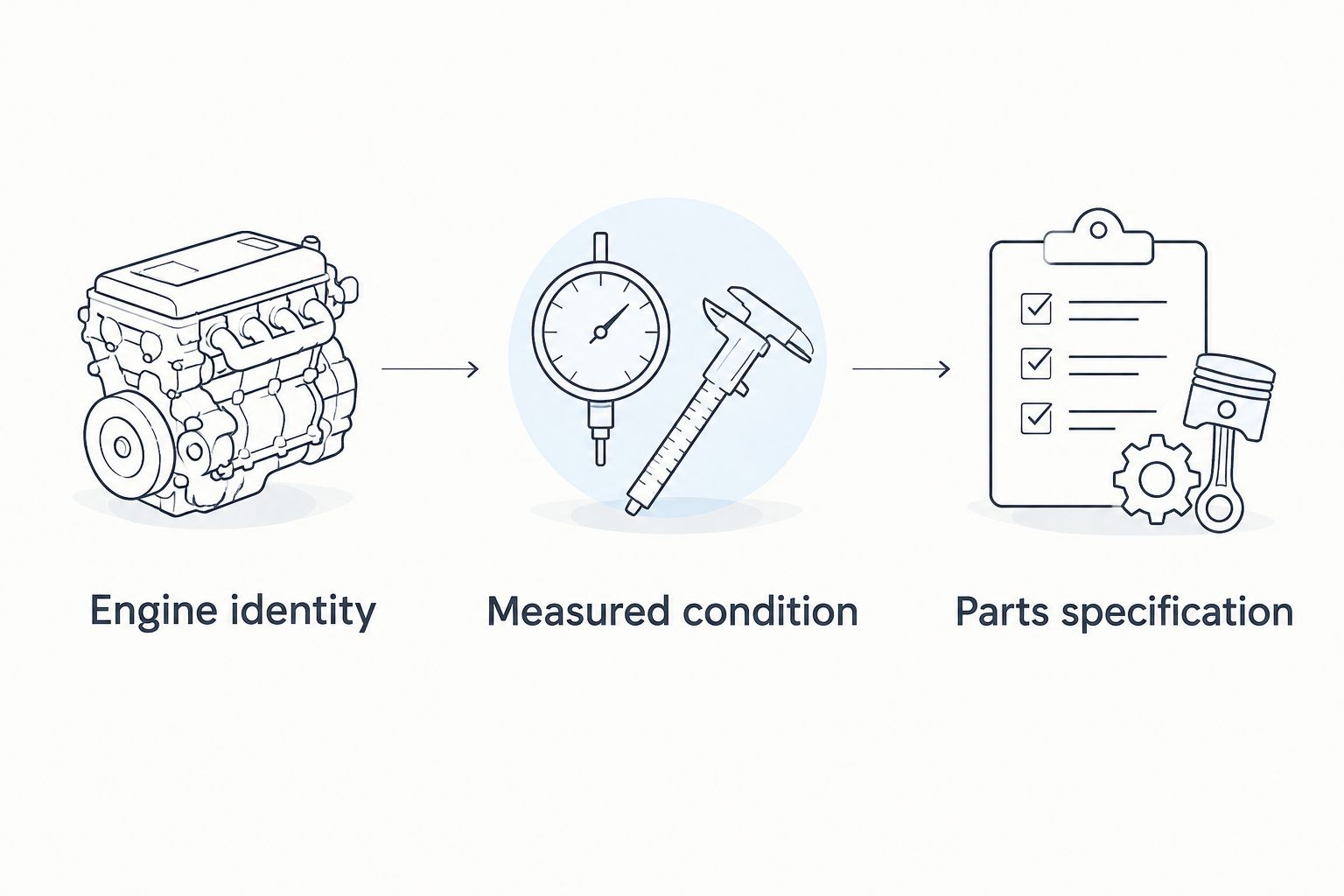
For a 2026 VW block rebuild, settle the dimensional decisions before placing the internal-parts order. Use these 3 checkpoints to keep the repair specification clear:
- Engine identity: Record the engine code and confirm the relevant repair documentation. Identify existing modifications that affect the proposed parts.
- Measured condition: Have the shop inspect the block, crankshaft, and pistons. Establish which components remain serviceable and which dimensions require correction.
- Parts specification: Match the machining plan to pistons, rings, bearings, seals, hardware, and supporting-system repairs. Confirm assembly contents rather than relying on a kit name.
Ask who owns each decision. The person selecting pistons and the person finishing the bores must work from the same specification; otherwise, the order and machining plan can disagree.
How the rebuild priorities are ranked
The ranking puts the foundation and measured internal fit first, followed by reassembly components and supporting systems. It uses engine identity, measured fit, failure correction, assembly compatibility, documentation, and repair scope—not advertised power gains.
This is not a product durability test. A lower-ranked component becomes essential when diagnosis identifies it as the failure source.
Which VW rebuild parts should you choose?
For an undecided owner, start with block inspection and a written repair specification. That is the default recommendation for 2026 because it establishes which purchases belong in the rebuild.
Choose bearings for confirmed bearing work, pistons and rings for confirmed cylinder-related repairs, and sealing parts for the joints you open. Add timing and cooling components according to the engine's condition and service requirements.
Do not spend the internal-repair budget on unrelated accessories. An upgrade is a separate decision from restoring a worn engine to its specified operating condition.
FAQ
What's the best VW block for a high-mileage rebuild?
The best starting point is your original VW block if inspection confirms it is serviceable for the intended repair. Replace it when damage or dimensional findings rule out that repair.
Should I replace a VW engine block just because mileage is high?
No—mileage alone does not establish that a VW engine block needs replacement. Base the decision on casting condition, measured dimensions, and the proposed repair.
Can new piston rings fix oil consumption?
New piston rings address ring-related problems only when the cylinders and associated components suit the repair. Diagnose bore wear, cylinder-head issues, and crankcase ventilation faults before ordering.
Can I order bearings before the crankshaft is inspected?
Wait until crankshaft inspection establishes the required bearing specification. Bearing selection must agree with journal condition, housing dimensions, and the applicable clearance requirements.
Is a VW water pump part of an engine rebuild?
A VW water pump belongs in the rebuild scope when diagnosis or the service procedure calls for cooling-system work. It supports coolant circulation but does not repair a damaged block.
Does a 2.0L designation prove water-pump compatibility?
No—a 2.0L designation alone does not prove compatibility. Confirm the engine code, applicable part reference, and assembly configuration before selecting a pump.
What should I buy first for a VW rebuild in 2026?
Establish the engine identity and obtain inspection results before buying dimensional internal parts. Use the resulting repair specification to select bearings, pistons, rings, and required reassembly components.
One last thing
Keep an untouched record of the failure before cleaning everything. Photograph damaged bearings, piston surfaces, and visible deposits, and label components by their original locations for the person diagnosing the engine.
Cleaning prepares parts for inspection and assembly, but the original damage pattern also carries information. Preserve that evidence before the rebuild turns every component into an anonymous clean part.